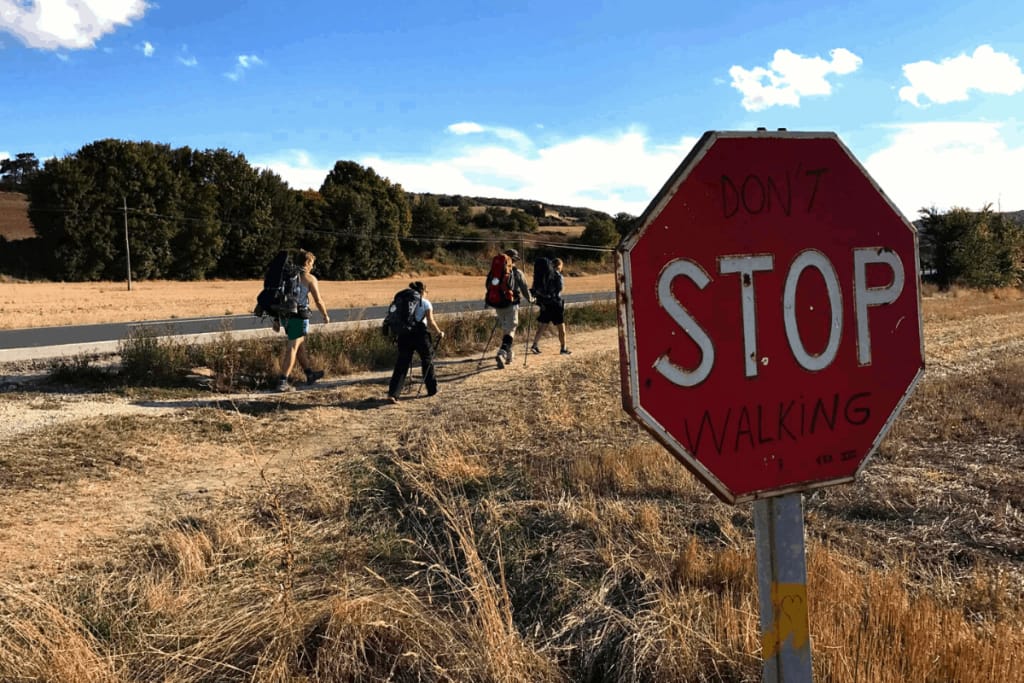
Everything you need to know before walking the Camino de Santiago. From hikers who have walked it
again and again since 2016.
Main routes
7 routes
Camino Francés
771 km
Typical duration
1 to 5 weeks
Pilgrims in 2024
Almost 500,000
When we set off for the Camino the first time, we believed, like most people, that there was only one
Camino. It turned out that the Camino de Santiago is a huge network of pilgrimage routes that all lead
to the same cathedral in Santiago de Compostela in north-western Spain. Since then it has become the
Camino Francés twice, the road out to Finisterre four times, the Camino Portugués and a long list of
smaller caminos at home in Denmark and around Europe.
This page is where you start. Here you get answers to what the Camino is, which routes you can choose
between, how long it takes, how to prepare, what to pack and what it all costs. Along the way we link
on to our guides that go deeper into each topic.
What is the Camino?
The Camino is the name most of us use for the Camino de Santiago. Camino simply means way in Spanish,
and Camino de Santiago means the way to Santiago. According to tradition, the apostle James lies buried
in the cathedral in Santiago de Compostela, and for more than a thousand years pilgrims from all over
Europe have walked there. In English the route is also known as
the Way of St James.
Today the Camino is far more than a religious journey. Almost 500,000 people reached Santiago in 2024,
and they walk for very different reasons: the nature, the challenge, the community, the reflection or
simply the joy of walking. You need to be neither Christian nor spiritual to have a great experience.
The way is well marked with yellow arrows and scallop shells, there are beds and food in almost every
village, and you meet people from all over the world, all walking towards the same goal.
There are many ways to Santiago, but seven routes carry by far the most pilgrims. When someone says the
Camino, they almost always mean the Camino Francés, the classic route from the books and the films.
Here are all seven, each with its own guide.
If you want to see the routes side by side with statistics on where the pilgrims walk, you will find it
all under Camino de Santiago.
How long is the Camino, and how long does it take?
There is no single answer, because the Camino is not one route. The Camino Francés is roughly 771
kilometres and typically takes 31 to 35 days, while the Camino Inglés can be walked in under a week.
Most pilgrims cover 20 to 25 kilometres a day, and you decide where to start. If you want the pilgrim
certificate, the Compostela, you simply need to walk at least the final 100 kilometres on foot.
Got a week?
Camino Inglés or the last 100 km
The Camino Inglés from Ferrol is a complete Camino of 5 to 6 days with a pilgrim certificate at the end. Alternatively you can walk the final 115 kilometres or so of the Camino Francés from Sarria, which very many pilgrims do.
10 to 12 days from Porto to Santiago, with the choice between the central route and the coastal route along the Atlantic. The kindest route on your legs and an excellent first Camino.
The complete experience of roughly 771 kilometres from Saint-Jean-Pied-de-Port across the Pyrenees to Santiago. This is the walk most people mean when they say they want to walk the Camino.
The short answer: spring and late summer. May, June and September give you the best balance of good
walking weather, open albergues and a trail that is not overcrowded. Those are the months we choose
ourselves when we can.
Spring and late summer
April to June and September to mid-October are high season for a reason. The temperatures are made
for walking, the landscape is green in spring and golden in autumn, and everything along the route
is open. In May and September you should book ahead or set off early, because you are far from
alone.
High summer
July and August are the hottest and busiest months. It can certainly be done, and the atmosphere is
lively, but on the Camino Francés the Meseta can get very hot in the middle of the day. Walk early,
take a siesta and drink more water than you think you need.
Winter
From November to March the way is quiet and beautiful, but a good number of albergues close, the
days are short, and the weather in the mountains can be rough. The Napoleon route across the
Pyrenees is closed in winter, when pilgrims are directed via Valcarlos instead. A winter Camino is
for those who have done it before.
Our recommendation
First Camino: late May or early September. If you want more quiet, consider the
Camino del Norte
or the Camino Primitivo,
which see fewer pilgrims all year round.
How to prepare
The good news first: the Camino requires no super fitness. The stages are manageable for most people
with ordinary condition, and your body settles into the rhythm after the first days. The best thing you
can do at home is walk. Take long walks in the shoes you plan to wear on the Camino, preferably with
your backpack packed, so feet, shoulders and mind all know what is coming. Our guide to
body and fitness
helps you set off stronger.
If you are considering going without company, the Camino is probably one of the easiest places in the
world to travel alone. You meet people the whole way, and you decide how much company you want. Read
our experience of walking the Camino alone.
And if your legs are not up for five weeks of walking, you can also read whether
you can cycle the Camino.
Your gear needs to be neither expensive nor advanced, but it has to be well thought through. The two
most important choices are
the backpack
and what you wear on your feet, including
the right socks.
Everything we have walked in, worn out and weighed you will find under
gear and packing.
Interactive packing list
Build your Camino packing list
Tick things off as you pack. The list is saved in your browser, so you can come back and finish later.
Try it here, then open the full list with one click.
Less than most people think. Spain is affordable, and the Camino infrastructure is built for pilgrims
on a budget. If you sleep in albergues, the special pilgrim hostels, and eat pilgrim menus, you can
expect around 30 to 40 euros a day. A bed typically costs 10 to 15 euros, a three course pilgrim menu
with wine around 10 to 12 euros, and the morning coffee with tostada a few euros.
If you cook in the albergue kitchens and shop in the supermarkets along the way, it can be done even
cheaper. In our experience, many pilgrims manage a whole month on the Camino for well under 1,500 euros
all included. The flight is often the single biggest expense. We made a full guide to
what food costs on the Camino,
with prices on everything from coffee to pilgrim menus.
Getting to the Camino
No major airport sits right at the Camino's classic starting points, so the journey there is usually a
combination. The good news is that it is easier than it sounds, because the infrastructure around the
routes is built for pilgrims.
To the Camino Francés. The starting town of
Saint-Jean-Pied-de-Port is usually reached by flying to Biarritz or Bilbao and continuing by train
or bus via Bayonne. If you start in Pamplona or Sarria instead, you can fly to Madrid and take a
train or bus onwards.
To the Camino Portugués. The easiest of them all: Porto
has direct flights from much of Europe, and the route starts in practice at the cathedral in the
city.
Home from Santiago. Santiago de Compostela has its own
airport with connections home via Madrid among others. Book your return with a couple of days of
buffer, so a sore achilles does not cost you the flight.
On each route page we describe the transport to that exact starting town, for instance for the
Camino Francés
and the Camino Portugués.
The practical side of the way
The pilgrim passport. You pick up your credencial in
the starting town, and along the way you collect stamps from albergues, churches and cafés. It is
your entry ticket to the albergues and your proof when you claim the Compostela in Santiago.
Finding the way. Yellow arrows and scallop shells
mark the route the whole way, and after a couple of weeks most pilgrims dream about them. If you
do get lost, there is always a local or another pilgrim pointing you back onto the trail.
The language. You get far with smiles and gestures,
but a few Spanish phrases open doors and get you better coffee. Practise with our
Spanish phrasebook
and look up the terms in the Camino glossary.
Not done in Santiago? Many pilgrims continue the
final ninety kilometres or so out to the Atlantic at
Cape Finisterre,
the place the Romans called the end of the world. It is the most beautiful epilogue a Camino can
get.
Frequently asked questions about the Camino
What is the Camino?
The Camino is the everyday name for the Camino de Santiago, a network of old pilgrimage routes that all lead to the cathedral in Santiago de Compostela in north-western Spain. Camino simply means way in Spanish. Read more in our article on what the Camino de Santiago is.
How long is the Camino?
It depends on the route. The Camino Francés, the classic route, is roughly 771 kilometres, while the Camino Inglés can be walked in about 116 kilometres. You decide where to start, and many pilgrims walk only a section. We wrote a whole article on the length and stages of the Camino.
How long does it take to walk the Camino?
The full Camino Francés typically takes 31 to 35 days. The Camino Portugués from Porto takes 10 to 12 days, and the Camino Inglés can be walked in under a week. Most pilgrims cover 20 to 25 kilometres a day.
How much does it cost to walk the Camino?
If you sleep in albergues and eat pilgrim menus, you can expect around 30 to 40 euros a day. Many pilgrims manage a whole month on the Camino for well under 1,500 euros all included. See our guide to what food costs on the Camino.
Can you walk the Camino alone?
Yes, and very many people do. The Camino is probably one of the easiest places in the world to travel alone, because you constantly meet other pilgrims and the infrastructure is built for walkers. Read our experience of walking the Camino alone.
When is the best time of year to walk the Camino?
May, June and September offer the best balance of weather, open albergues and space on the trail. July and August are the hottest and busiest months, while winter means closed albergues and rough weather in the mountains.
Do you have to be religious to walk the Camino?
No. The Camino began as a Christian pilgrimage to the tomb of the apostle James, but today people walk it for all kinds of reasons: the nature, the challenge, the reflection or simply the joy of a long walk. Everyone is welcome on the way.
Which Camino route should I choose?
If it is your first Camino and you have the time, choose the Camino Francés. With two weeks, the Camino Portugués from Porto is the obvious pick, and with only a week the Camino Inglés gives you a complete Camino with a pilgrim certificate. See all the routes side by side under Camino de Santiago.
Ready to go further?
The Camino begins long before the first stage. Explore the routes, the guides and everything we have
learned on the way since 2016.