Routes · Spain
The Way of St James: the history behind the Camino
The Way of St James is the old name for the Camino de Santiago. Here is the history: Saint James, the scallop shell, the medieval pilgrims and the revival.
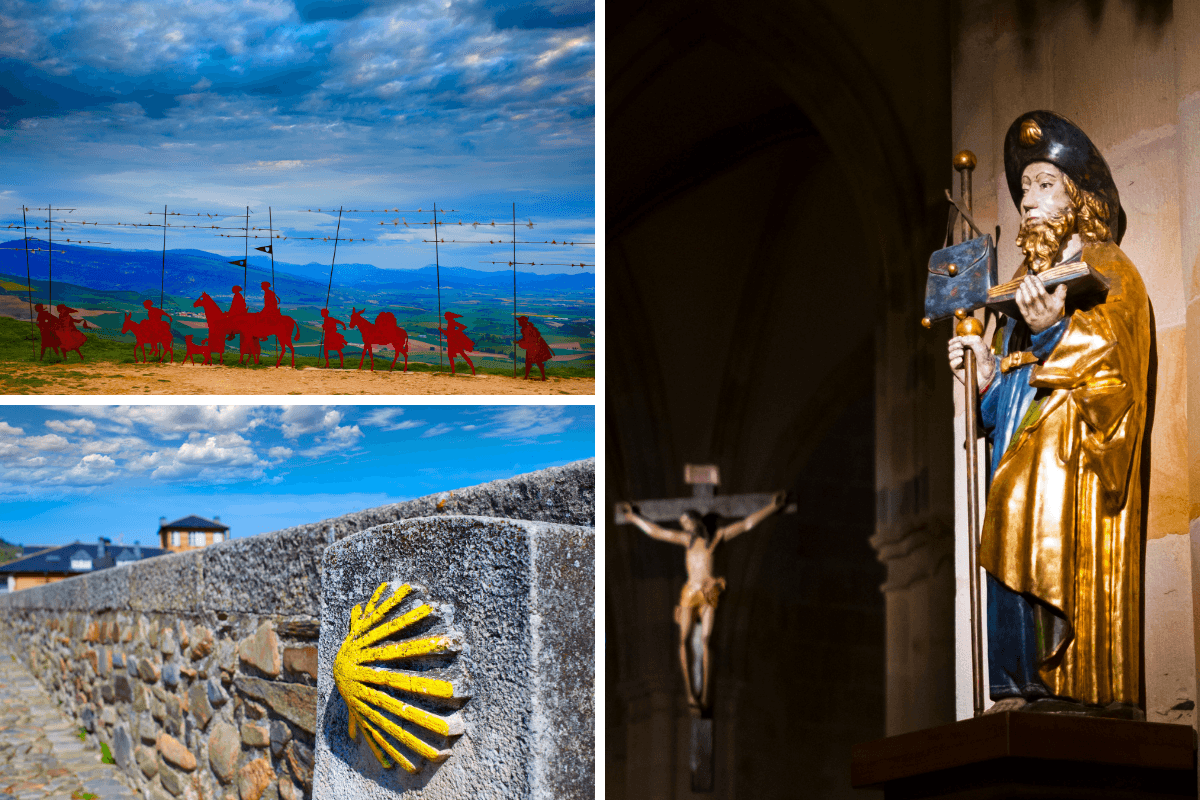
Saint James the Greater was one of Jesus’s twelve disciples. He is depicted with a walking staff and a scallop shell, and he is the patron saint of Spain. His name sits inside everything: Santiago is the Spanish form of Saint James, Camino de Santiago means the way to Santiago, and in English the route is known as the Way of St James.
The Way of St James is therefore not one trail but the same thing as the Camino: a network of old pilgrimage routes across Europe that all run together at the cathedral in Santiago de Compostela in north-western Spain. When people say the Way, they usually mean the Camino Francés, the classic route of roughly 771 kilometres from Saint-Jean-Pied-de-Port. But the history behind it is much bigger than one route, and it reaches back more than a thousand years.
The legend of Saint James
According to tradition, James travelled to the Iberian Peninsula to spread Christianity before returning to Jerusalem, where he was martyred around the year 44. The story says his companions sailed his body to Galicia and buried it there, after which the tomb was forgotten for centuries.
Then, in the 9th century, tradition tells of a hermit named Pelayo who was led to the tomb by a strange light, and of the bishop Teodomiro who declared it the resting place of the apostle. A church was raised over the tomb, a town grew up around it, and the name Compostela is popularly linked to campus stellae, the field of the star. Linguists lean towards more down-to-earth explanations, but the star story is a beautiful part of the way’s mythology.
The 25th of July is Saint James’s Day, and when it falls on a Sunday, Santiago celebrates a Holy Year, an Año Santo, when the cathedral opens the Holy Door and the way traditionally sees more pilgrims than usual.
The medieval pilgrim highway
From the 11th and 12th centuries Santiago grew into one of the three great pilgrimage destinations of Christendom, alongside Rome and Jerusalem. Bridges, hospitals and monasteries were built along the routes, and in the 12th century someone even compiled a kind of medieval guidebook, the Codex Calixtinus, with practical advice on stages, rivers not to drink from, and places to see. Much of the infrastructure you walk on today, including many of the bridges, dates from that period.
The scallop shell became the pilgrim’s badge. Pilgrims who reached Santiago and carried on to the coast brought a shell home as proof of the journey, and over time the shell became the symbol of the way itself. Today it is still the shell and the yellow arrow that show the way, and you can look up the terms in our Camino glossary.
After the Reformation and through several turbulent centuries, the stream of pilgrims dried up. As late as the 1980s, only a few thousand pilgrims a year reached Santiago.
The revival: from forgotten path to world route
Through the 1980s and 1990s the way came back to life. The routes were re-marked with the yellow arrows, the albergue network was rebuilt, and the Camino Francés was inscribed on the UNESCO World Heritage list in 1993. Since then it has only gone one way: in the record year of 2024, almost 500,000 pilgrims received their Compostela in Santiago, and more than half came from outside Spain.
Northern Europe has its own part of the story. Medieval pilgrims from Scandinavia walked south along routes such as Denmark’s Hærvejen, one of the northern feeder roads towards Europe and, in the end, Santiago. If you like the idea of starting from home, have a look at our hiking routes.
What does it take to walk the Way of St James today?
Anyone who can walk can walk the Way of St James. You pick up a pilgrim passport, a credencial, in your starting town and collect stamps from albergues, churches and cafés along the way. The passport is your entry ticket to the albergues and your proof when you claim the Compostela in Santiago. The certificate requires that you have walked at least the final 100 kilometres on foot, which is why Sarria on the Camino Francés is the most used starting town of all today.
You need to be neither Christian nor a historian before you set off. The way has welcomed every kind of traveller for a thousand years, and the reflection comes by itself out there between the villages. When you are ready for the practical side, start with the big guide to walking the Camino, see the routes side by side under Camino de Santiago, and go deeper into what the Camino de Santiago really is.
I have had some of the best experiences of my life on the Way of St James, and the history is a big part of the magic: you are quite literally walking in thousand year old footsteps. Thank you for reading.
Frequently asked questions
What is the Way of St James?
Why is it called the Way of St James?
What is the symbol of the Way of St James?
How old is the Way of St James?
What does it take to walk the Way of St James?
Do you have to be Christian to walk the Way of St James?
Camino King
The walker who never stopped
Michael walked his first Camino in 2016 and has kept going ever since. He writes about the routes, the gear and everything that makes a long walking day good. If it is here, it has been walked, worn or weighed.
Read next
Planning
I brought my laptop on the Camino, here's what actually happened
I brought my laptop on the Camino de Santiago. Here is how working a few hours a day on a pilgrimage actually feels, and whether you should try it.
Mindset
Camino tattoo ideas, and the sunburn lesson I learned the hard way
Many pilgrims mark the Camino with a tattoo. Here is inspiration for your Camino tattoo, a real pilgrim's story and a lesson I learned the hard way.
Planning
Cycling the Camino: yes, even Ronaldo has done a stretch
Yes, you can cycle the Camino de Santiago. Here is what to expect from the terrain, the daily distances and how to prepare your bike and body.