The ways to Santiago
Camino Francés
The classic route, and the one most people mean when they say the Camino.
- Distance
- 771 km
- Time
- 31 to 35 days
- Stages
- 33 classic stages
- Difficulty
- Moderate
Starts in Saint-Jean-Pied-de-Port, France
The ways to Santiago
The classic route, and the one most people mean when they say the Camino.
Starts in Saint-Jean-Pied-de-Port, France
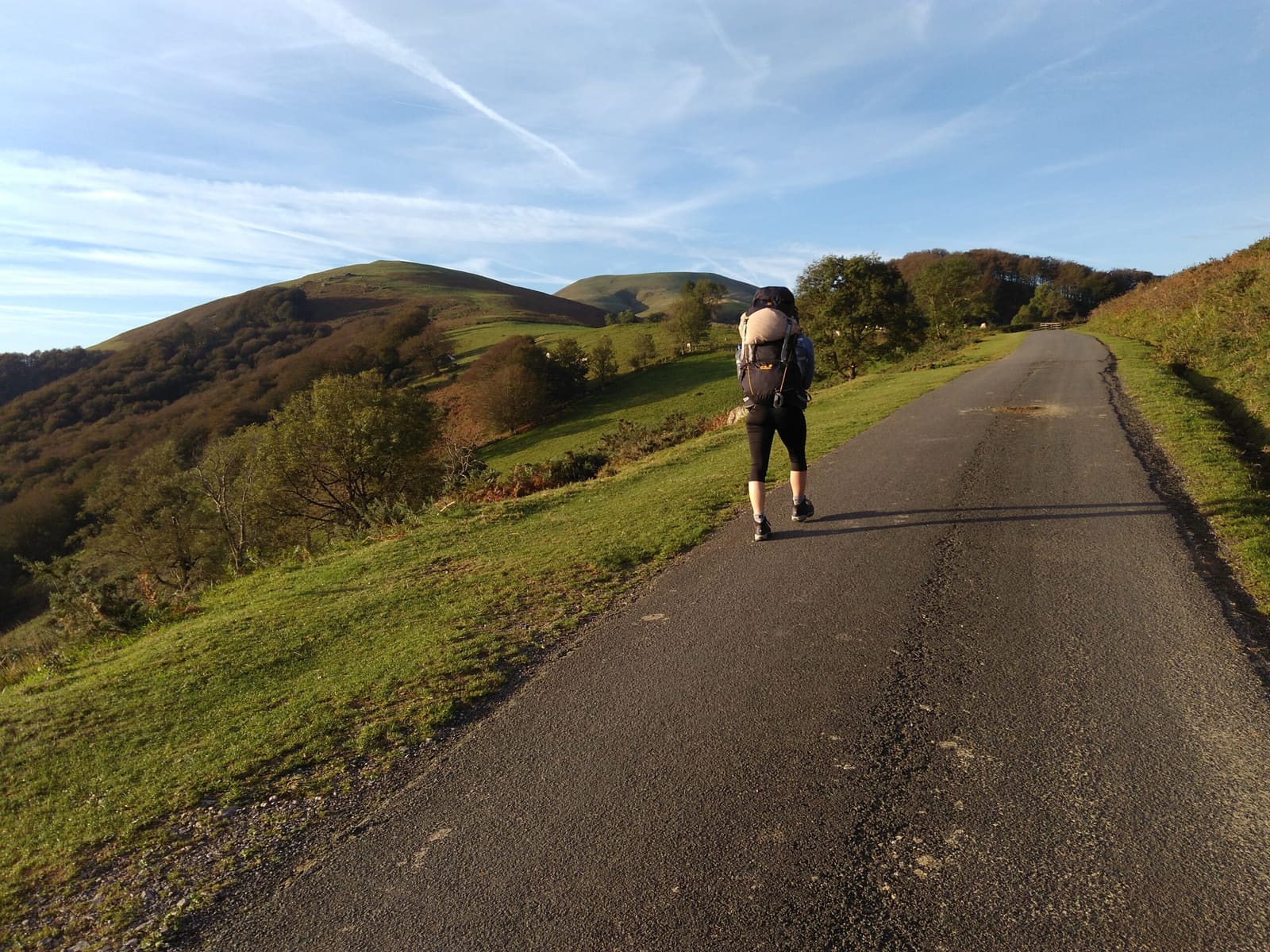
The Francés is the Camino from the books and the films. It crosses the Pyrenees on the first day and then rolls on through Pamplona, the vineyards of Rioja, the wide meseta after Burgos and the mountains of León, before the green hills of Galicia carry you into Santiago.
It is the route with the most pilgrims, the most albergues and the strongest infrastructure. If this is your first Camino and you want the full experience, arrows everywhere, company when you want it and quiet when you need it, then this is the one.
When we set off on the Camino Francés for the first time, we knew nothing about the Camino. We had a cheap and far too heavy backpack and a pair of untested hiking boots, and it still turned out to be the best month of our lives. When people ask us when we have been happiest, we still answer without hesitation: the Camino Francés.
It is the Camino from the books and the films, the one most people mean when they simply say the Camino. Originally it is a pilgrimage to the tomb of the apostle James in Santiago de Compostela, but you do not need to be Christian or spiritual to have wonderful experiences. For us it was as much about the people we met as about the road itself. You come away richer in stories, not only about your own life but about other people's too.
What makes the Francés special is how civilised it is. Countless books and films have been made about the route, and along the way you find just about anything your heart desires. The hospitality was overwhelming every time we arrived somewhere new, and even when a place was overbooked, we found somewhere to sleep. After a couple of weeks most people dream of yellow arrows and scallop shells, that is how well it is waymarked.
The first day's climb from France over the mountains to the monastery at Roncesvalles. A hard start, but one of the most beautiful stages on the whole route.
The first real city, famous for the running of the bulls. Tapas bars, a lively old town and a good place to celebrate the first week.
Rolling wine country around Logroño and Nájera, where the path winds between the rows. Some wineries even have a pilgrim fountain that pours wine.
The great high plateau between Burgos and León. Open skies, grain fields to the horizon and long, meditative days that many people end up loving.
The iron cross in the mountains near Foncebadón, where pilgrims lay a stone brought from home. The route's most symbolic stop and a quiet moment for many.
The green climb into Galicia with thatched Celtic houses and mist over the valleys. From here Santiago feels close.
When you walk across Spain, you meet all of it. The terrain is hugely varied, from the mountain crossing over the Pyrenees on the first day to gravel tracks, tarmac, forest and the wide meseta after Burgos. It is a cross country trek in the best sense of the words. Finding your way, on the other hand, is easy. The route is so well marked with yellow arrows and scallop shells that most people quickly find their way back if they stray a little. The difficulty lies mostly in the total distance. We walked the route in 26 days, but if you follow the official stages, you get a gentler pace. The individual days are manageable for most people in ordinary shape.
If this is your first Camino and you want the full experience with company when you want it, and quiet when you need it, then this is the one. Our best advice, though, is to avoid being too set in your expectations. We have seen that the people who struggle on the Camino are often the ones who have prepared so much that the route cannot live up to the picture in their head. If you have decided in advance that the trip has to change your whole life, you can end up spoiling your own anticipation. Walk with an open mind, and the Francés delivers the rest.
Most people travel to Biarritz or Bayonne in France and from there take the little regional train or a shuttle bus up to Saint-Jean-Pied-de-Port. From Denmark the simplest way is usually a flight to Biarritz or Bilbao and onward by train and bus. Arrive in Saint-Jean the day before, so you can collect your pilgrim passport and start the Pyrenees stage rested and early the next morning.
The classic division is 33 stages of 18 to 29 kilometres a day. No rule says you have to follow it. The towns sit close together, so you can always walk shorter or longer. The kilometre figures are the commonly cited approximations.
| Stage | From | To | Approx. km |
|---|---|---|---|
| 1 | Saint-Jean-Pied-de-Port | Roncesvalles Napoleon route; winter variant via Valcarlos approx. 23.4 km | 24.2 |
| 2 | Roncesvalles | Zubiri | 21.4 |
| 3 | Zubiri | Pamplona | 20.4 |
| 4 | Pamplona | Puente la Reina | 23.9 |
| 5 | Puente la Reina | Estella | 21.6 |
| 6 | Estella | Los Arcos | 21.3 |
| 7 | Los Arcos | Logroño | 27.6 |
| 8 | Logroño | Nájera | 28.5 |
| 9 | Nájera | Santo Domingo de la Calzada | 20.7 |
| 10 | Santo Domingo de la Calzada | Belorado | 22 |
| 11 | Belorado | San Juan de Ortega | 23.9 |
| 12 | San Juan de Ortega | Burgos | 25.8 |
| 13 | Burgos | Hornillos del Camino | 20.3 |
| 14 | Hornillos del Camino | Castrojeriz | 19.9 |
| 15 | Castrojeriz | Frómista | 24.7 |
| 16 | Frómista | Carrión de los Condes | 18.8 |
| 17 | Carrión de los Condes | Terradillos de los Templarios | 26.3 |
| 18 | Terradillos de los Templarios | Bercianos del Real Camino | 23.2 |
| 19 | Bercianos del Real Camino | Mansilla de las Mulas | 26.3 |
| 20 | Mansilla de las Mulas | León | 18.4 |
| 21 | León | San Martín del Camino Variant via Villar de Mazarife approx. 21.1 km | 24.6 |
| 22 | San Martín del Camino | Astorga | 23.7 |
| 23 | Astorga | Foncebadón | 25.8 |
| 24 | Foncebadón | Ponferrada Over the Cruz de Ferro, the highest point of the Camino | 26.8 |
| 25 | Ponferrada | Villafranca del Bierzo | 23.2 |
| 26 | Villafranca del Bierzo | O Cebreiro | 27.8 |
| 27 | O Cebreiro | Triacastela | 20.6 |
| 28 | Triacastela | Sarria Via San Xil; via Samos approx. 24.7 km | 17.8 |
| 29 | Sarria | Portomarín | 22.2 |
| 30 | Portomarín | Palas de Rei | 24.8 |
| 31 | Palas de Rei | Arzúa | 28.5 |
| 32 | Arzúa | O Pedrouzo | 19.3 |
| 33 | O Pedrouzo | Santiago de Compostela | 19.4 |
If you only want the Compostela, you need to walk at least the final 100 kilometres on foot, which is why Sarria (stage 29) is the most used starting town on the whole Camino. Read more about the length and stages of the Camino.
Almost every stage town has a public albergue: municipal, parish or Xunta-run. Here is the best known one in each town. Prices are 2026 level, approximate, and they change; donativo means a voluntary donation. In Galicia every Xunta albergue costs the same.
| Town | Albergue | Type | Approx. € | Beds |
|---|---|---|---|---|
| Saint-Jean-Pied-de-Port | Ospitalia Refuge Municipal | Municipal | 16 | 34 |
| Roncesvalles | Albergue de peregrinos de Roncesvalles | Church-run | 15 | 183 |
| Zubiri | Albergue municipal de Zubiri | Municipal | 16 | 28 |
| Pamplona | Albergue Jesús y María | Municipal | 12 | 112 |
| Puente la Reina | Albergue de los Padres Reparadores | Religious order | 9 | 100 |
| Estella | Albergue de peregrinos de Estella | Municipal | 8 | 44 |
| Los Arcos | Albergue Isaac Santiago | Municipal | 8 | 70 |
| Logroño | Albergue de peregrinos de Logroño | Municipal | Donativo | 56 |
| Nájera | Albergue de peregrinos de Nájera | Municipal | 7 | 48 |
| Santo Domingo de la Calzada | Casa del Santo | Confraternity | 13 | 164 |
| Belorado | Albergue parroquial de Belorado | Parish | 10 | 20 |
| San Juan de Ortega | Albergue parroquial San Juan de Ortega | Parish | 15 | 30 |
| Burgos | Casa del Cubo y de los Lerma | Municipal | 10 | 120 |
| Hornillos del Camino | Albergue de peregrinos de Hornillos | Municipal | 14-15 | 24 |
| Castrojeriz | Albergue San Esteban | Municipal | 9 | 35 |
| Frómista | Albergue de peregrinos de Frómista | Municipal | 15 | 56 |
| Carrión de los Condes | Albergue parroquial Santa María | Parish | 10 | 50 |
| Terradillos de los Templarios | Albergue Los Templarios | Private | 17 | 46 |
| Bercianos del Real Camino | Albergue parroquial Casa Rectoral | Parish | Donativo | 44 |
| Mansilla de las Mulas | Albergue de peregrinos de Mansilla | Municipal | 7 | 28 |
| León | Albergue del convento de las Carbajalas | Convent | Donativo | 85 |
| San Martín del Camino | Albergue de San Martín del Camino | Municipal | 10 | 46 |
| Astorga | Albergue Siervas de María | Association | 8 | 156 |
| Foncebadón | Albergue parroquial Domus Dei | Parish | Donativo | 18 |
| Ponferrada | Albergue parroquial San Nicolás de Flüe | Parish | Donativo | 186 |
| Villafranca del Bierzo | Albergue de peregrinos de Villafranca | Municipal | 10 | 60 |
| O Cebreiro | Albergue de peregrinos de O Cebreiro | Xunta | 10 | 104 |
| Triacastela | Albergue de peregrinos de Triacastela | Xunta | 10 | 56 |
| Sarria | Albergue de peregrinos de Sarria | Xunta | 10 | 40 |
| Portomarín | Albergue de peregrinos de Portomarín | Xunta | 10 | 86 |
| Palas de Rei | Albergue de peregrinos de Palas de Rei | Xunta | 10 | 24 |
| Arzúa | Albergue de peregrinos de Arzúa | Xunta | 10 | 56 |
| O Pedrouzo | Albergue de Arca - O Pino | Xunta | 10 | 150 |
| Santiago de Compostela | Residencia San Lázaro | Xunta | 10 | 80 |
Verified against gronze.com and the official Xunta de Galicia albergue pages, August 2026. Always check opening times in the shoulder season, and never try to book public albergues ahead; they work strictly first come, first served.
With public albergues and pilgrim menus, most pilgrims land around 30 to 40 euros a day: a bed typically costs 7 to 16 euros, a pilgrim menu around 10 to 12 euros, and the rest goes on lunch, coffee and the occasional treat. A full five week Camino Francés can therefore be done for roughly 1,300 to 1,500 euros plus the flight, and cheaper if you cook for yourself.
See what food costs in our guide to food on the Camino, and pack with our Camino packing list with checkboxes that remember how far you have come.
May, June and September are the best months: long days, open albergues and gentler heat than in July and August. Winter is possible, but quiet, and a few high stretches demand respect.