Pilgrim passport and Compostela: how to get them
The pilgrim passport gives access to the albergues, and the stamps prove you walked. Here is where to get it, how to collect stamps, and what is required.
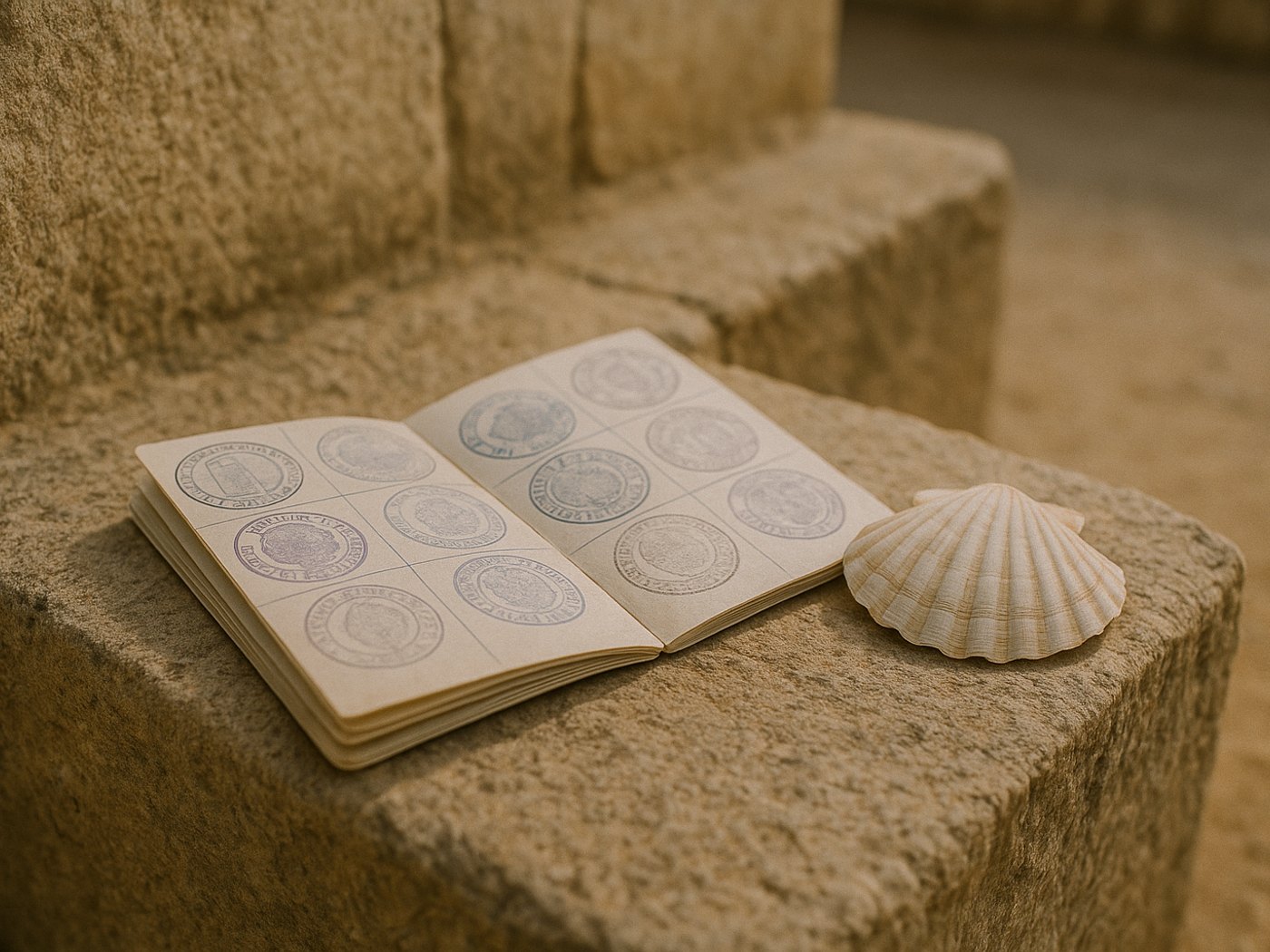
Photo: AI-generated
The pilgrim passport, the credencial del peregrino, is the document that makes you a pilgrim rather than a tourist. It gives access to the albergues, it is stamped along the way, and it is the proof when you stand in Santiago and want your Compostela.
The short answer: get it before you leave home or in your starting town, collect one stamp a day and two on the last hundred kilometres, and walk at least a hundred continuous kilometres on foot.
What the pilgrim passport is for
Three things, and all of them are practical:
- Access to the albergues. The municipal and parish ones only let pilgrims in, and the passport is what shows that you are one. More about them in albergues on the Camino.
- The documentation of your route. The stamps show where you have been, and when.
- Your own keepsake. It is the thing people hang up afterwards. Forty stamps from forty places where you slept, ate and rested your feet.
Where to get it
There are three ways, and all of them are fine:
Before you leave home, through a pilgrim association. The advantage is that it is ready in your bag when you travel, and that you can start collecting stamps from the first day.
In your starting town. In Saint-Jean-Pied-de-Port the pilgrim office hands them out, and in Porto you buy it in the cathedral shop. In Sarria and most other starting towns you ask at the parish church or at an albergue, because parish churches, albergues, pilgrim associations and confraternities are the ones the cathedral in Santiago has authorised to hand out the passport. It costs a small amount, and this is the most common solution.
Along the way, if you started without one. Many albergues and parish churches have them.
How to collect stamps
The stamp is called a sello, and you get it by holding out your passport. It takes five seconds, and people are used to it.
- The albergue stamps on arrival, almost always automatically.
- Churches, monasteries and cathedrals stamp, and they often have the most beautiful ones.
- Bars, cafés and bakeries along the route have their own, and they are happy to join in.
- Tourist offices in the larger towns.
The rule is one stamp a day on most of the route. On the last hundred kilometres there have to be at least two a day. The pilgrim office in Santiago asks for a dated stamp at the start and at the end of each stage, to show that you walked on from the place where you stopped.
The requirements for a Compostela
Two numbers have to be in place:
- A hundred continuous kilometres on foot, or two hundred by bicycle. The pilgrim office requires them to be on the same recognised route, and the final stage into the cathedral in Santiago has to be included. You may walk it over several trips, as long as the stages follow in order. That is why Sarria is such a popular starting town.
- Stamps that document it, with at least two a day on the last hundred kilometres.
Can you cycle the whole way? Yes, and the rules are different. That is described in cycling the Camino.
At the pilgrim office in Santiago
The office is a few minutes from the cathedral. You take a number, wait, and have your Compostela written out with your name in Latin. It is free.
If you want more, there are two things:
- The distance certificate, which shows where you started and how many kilometres you walked. It costs a small fee.
- A tube to carry it home in, which is the best small investment in the whole project. A Compostela that has been folded in a backpack is a Compostela that has been folded.
Come early in the day in high season. In July and August the queue can be long, and you can get a number digitally in advance.
The last stamp
There is one thing people talk about afterwards. It is the stamp in the last albergue, where you know there are twelve kilometres left.
The whole picture of the routes and what they require is in the Camino de Santiago and its many routes, and the story behind the name in the Way of St James.
Frequently asked questions
Where do I get a pilgrim passport?
How many stamps do I need?
How far do I have to walk to get a Compostela?
Does the Compostela cost anything?
Camino King
The walker who never stopped
Michael walked his first Camino in 2016 and has kept going ever since. He writes about the routes, the gear and everything that makes a long walking day good. If it is here, it has been walked, worn or weighed.
Read next
 Routes What is the Camino de Santiago? A short explanation The Camino de Santiago is a network of pilgrimage routes to Santiago de Compostela in Spain. Here is how it works and where to go next.
 Planning Albergues on the Camino: how pilgrim hostels work Albergues are a big part of what makes the Camino the Camino. Here are the three types, what they cost, and the unwritten dormitory rules at night.
 Routes The Way of St James: the history behind the Camino The Way of St James is the old name for the Camino de Santiago. Here is the history: Saint James, the scallop shell, the medieval pilgrims and the revival.