Camino shell and yellow arrow: meaning and origin
The scallop shell has marked Santiago pilgrims since the 12th century, and the yellow arrow dates from 1984. See what the Camino symbols mean.
The scallop shell is the pilgrim’s old badge, and the yellow arrow is the waymark of the route. The shell is documented as a badge for pilgrims to Santiago de Compostela from the 12th century. The arrow is far younger. According to the Xunta de Galicia, it was painted along the Camino Francés in 1984 by the priest Elías Valiña of O Cebreiro.
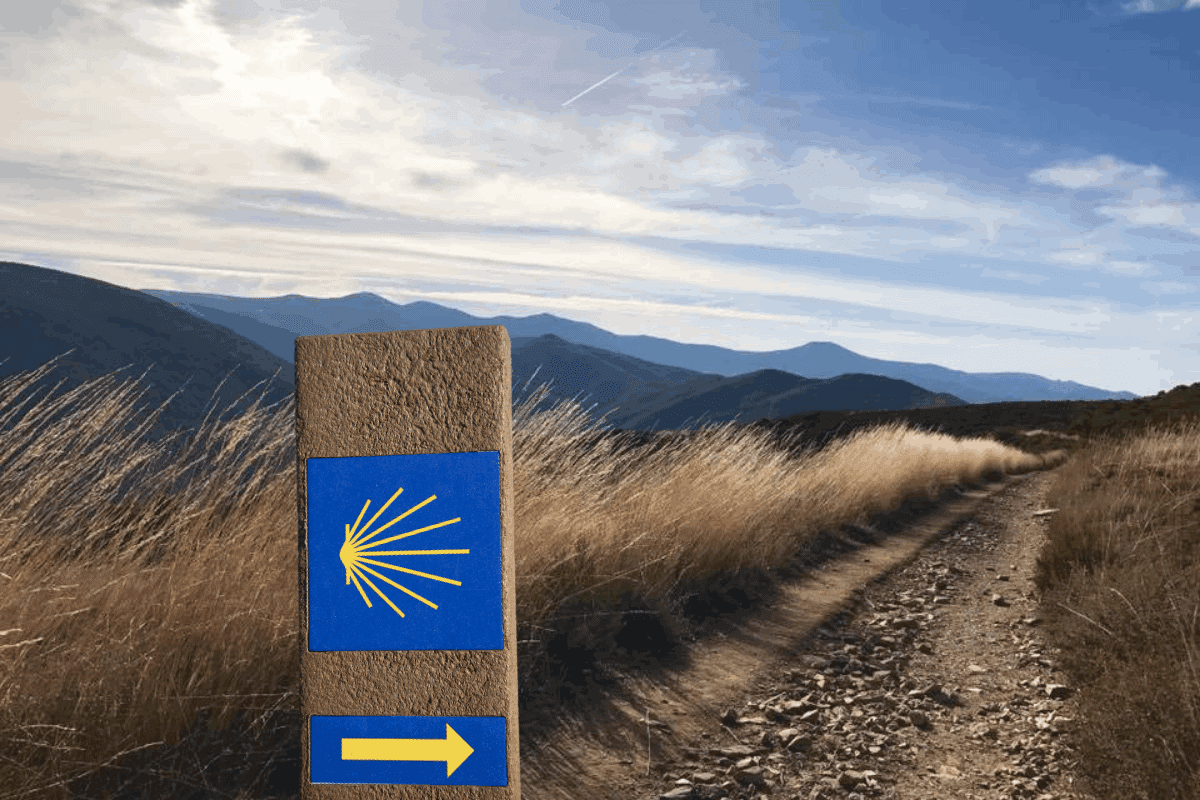
Today the two are used together. The arrow shows the direction, and the shell shows that you are on a Camino route. The orientation of the shell follows no fixed rule, so the arrow is the sign to walk by.
| Symbol | What it is | Dates from |
|---|---|---|
| The scallop shell | The pilgrim’s badge and the mark of the route | 12th century |
| The yellow arrow | Shows the direction on the route | 1984 |
| Yellow shell on blue | The Council of Europe emblem for the cultural route | 1987 |
| The cross of Saint James | The emblem of the Order of Santiago | The order was founded in 1170 |
| Staff, pouch and gourd | The pilgrim’s equipment | Seen in images of Saint James from the 12th century |
What the scallop shell means
The shell is called vieira in Galician and Spanish, and concha is the Spanish word for a shell. It is the great scallop, Pecten maximus, which is found on the Galician coast.
The pilgrimage museum in Santiago, the Museo das Peregrinacións e de Santiago, calls the shell the most emblematic symbol of the pilgrimage to Santiago. Hung or sewn onto clothing, it served as proof that the wearer was a pilgrim. Rome had the crossed keys as its badge in the same way, and Jerusalem had the palm.
The museum names several layers of meaning:
- The Veneranda dies sermon in the Codex Calixtinus gives the shell a healing value and lets its likeness to a hand stand for good works.
- The shell has been a symbol since Greek and Roman antiquity. It is tied to water and so to life, and the goddess Venus is born from a shell.
- A legend of Saint James tells that he saves a knight from the sea, and that the knight’s armour is covered in shells.
Where the tradition comes from
The oldest shell the museum shows was found in a tomb in the cathedral of Santiago and dates from before 1120. It has two holes, which show that a pilgrim wore it as a badge in the 12th century. The museum writes that back then you only received the shell on arrival in the city and wore it on the way home.
According to UNESCO’s Memory of the World, the Codex Calixtinus was compiled between 1138 and 1173 and consists of five books. The third book tells of the first pilgrims gathering shells on the Galician coast as souvenirs.
The trade in shells was tightly controlled. According to the museum, they were sold at the north entrance of the cathedral under the control of the church, and one of the oldest guilds in the city, the concheiros, held the monopoly on making and selling badges shaped like shells in various materials. The Xunta de Galicia writes that the shell could only be sold in Santiago de Compostela, and that the Os Concheiros neighbourhood in the north of the city takes its name from the trade.
The rest of the story of the apostle, the tomb and the medieval pilgrims is in the article on the history of the Way of St James.
The shell as a waymark today
In 1987 the Council of Europe declared the Camino the first European Cultural Route. According to the Spanish federation of Camino associations, the official symbol is a stylised yellow scallop shell on a blue background, and the Xunta de Galicia writes that the current design of the shell is the one the Council of Europe adopted in 1987. That is the shell you see on signs and marker stones along the routes.
The orientation of the shell is not the same everywhere. According to the Camino site Albergues del Camino, you often hear that the ribs point towards Santiago, or that the meaning changes inside and outside Galicia, but there is no universal rule that lets you decide a turn from the shell alone. Albergues del Camino also writes that the Spanish council Consejo Jacobeo approved guidelines in 2018 to harmonise the waymarking. El Camino con Correos, the Spanish postal service’s site about the Camino, writes that since 2018 the yellow arrow is the only sign that marks the direction, and that the shell shows you are on one of the routes to Santiago.
How arrows, shells and distance stones work in practice is covered in the guide to Camino maps.
The yellow arrow and Elías Valiña
According to El Camino con Correos, Elías Valiña Sampedro was born in Sarria in 1929 and was parish priest of O Cebreiro from his ordination in 1957 until his death on 11 December 1989. He wrote a doctoral thesis on the history and law of the Camino, and the Xunta de Galicia states that he published guides to the route in many editions and worked to restore the church of O Cebreiro.
In 1984, according to the Xunta de Galicia, he personally marked out the entire Camino Francés from Roncesvalles to Santiago with yellow arrows. The following year he was named commissioner of the Camino at the first Jacobean meeting in Santiago.
On the colour, the sources disagree. The Xunta de Galicia writes that the choice was random, because Valiña used paint left over from painting signs on the N-VI road. El Camino con Correos reports the family’s account: Valiña had seen painted marks on mountain routes in France and chose yellow because the colour could be seen on any material and in any weather.
There were far fewer pilgrims then. The Pilgrim’s Reception Office in Santiago states that 1,245 pilgrims arrived in 1985. In the Holy Year of 2010, 272,703 received a Compostela.
Other symbols of the Camino
The cross of Saint James. The red cross shaped like a sword is, according to the pilgrimage museum, the emblem of the Order of Santiago, a military order. The shape stands for the faith and the weapons to defend it, and the red colour stands for the blood of the apostle. According to the Spanish federation of Camino associations, the order was founded in 1170. The federation writes that the cross belongs to the order alone and is now sometimes used incorrectly for anything to do with Saint James.
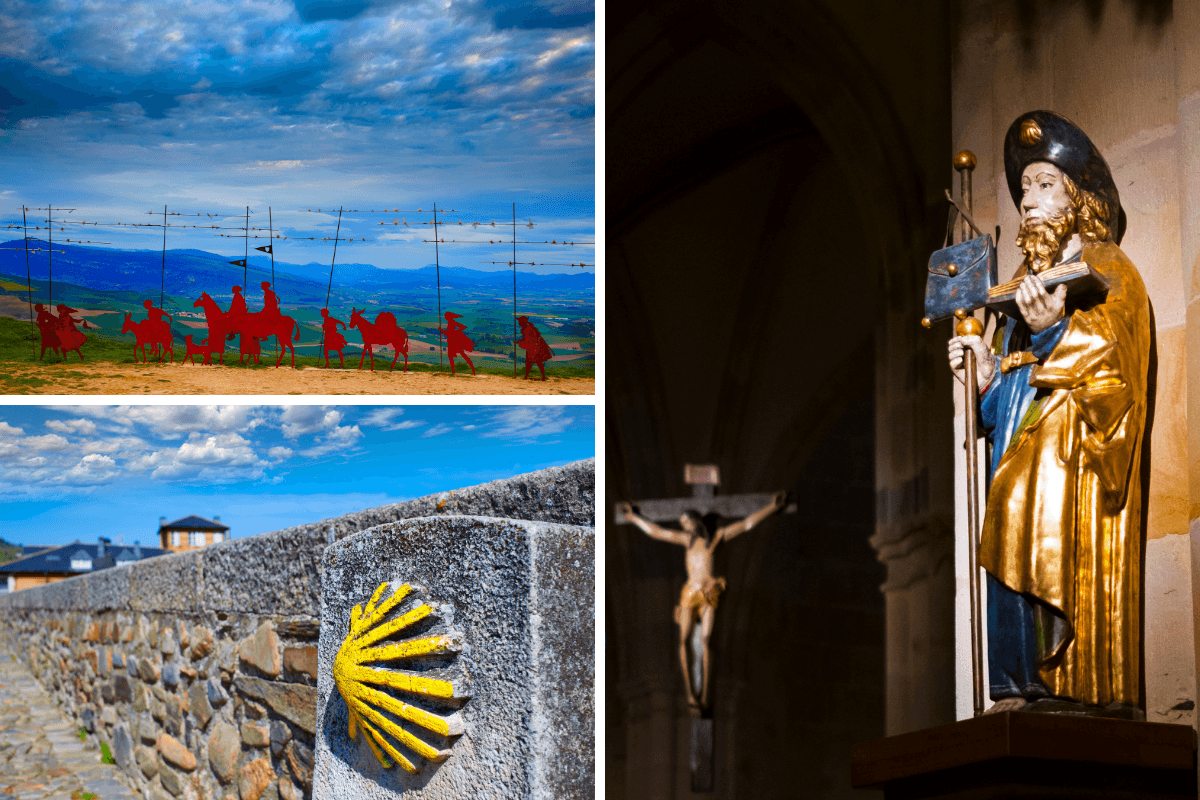
Staff, pouch and gourd. The staff, bordón in Spanish, and the pouch became the marks of the pilgrim according to the museum, and the gourd was added later, a hollowed-out vessel for water or wine. Before departure a pilgrim could have the staff and pouch blessed. From the 12th century, Saint James himself is shown as a pilgrim with staff, pouch, gourd, hat, shoulder cape and shells.
The botafumeiro. The great censer in the cathedral of Santiago weighs about 53 kilos according to the cathedral, is about 1.50 metres tall and is swung by eight men, the tiraboleiros. The censer normally used is made of brass and was made by José Losada in 1851. More on the cathedral is in the guide to arriving in Santiago.
The Spanish words are explained in the Camino glossary, and the overview of routes and history is on the page about the Camino de Santiago.
Why the symbols end up as tattoos
The scallop shell and the yellow arrow are the obvious motifs for a Camino tattoo. The explanation lies in what they stand for. Since the 12th century the shell has shown that its wearer is a pilgrim, and according to the Spanish federation of Camino associations, medieval pilgrims carried it home as proof that they had reached Santiago. The arrow is the sign you follow every day from the moment you set out in the morning.
If you are considering the cross of Saint James, be aware that it is first of all the emblem of the Order of Santiago. No count was found of how many pilgrims get a tattoo, so this article gives no figures.
Pictures and ideas for motifs are in the article on Camino tattoos.
Frequently asked questions
What does the Camino de Santiago shell mean?
Where does the scallop shell tradition come from?
Who invented the yellow arrow on the Camino?
Why is the Camino arrow yellow?
Which way does the Camino shell point?
Which symbols suit a Camino tattoo?
Camino King
The walker who never stopped
Michael walked his first Camino in 2016 and has kept going ever since. He writes about the routes, the gear and everything that makes a long walking day good. If it is here, it has been walked, worn or weighed.
Read next
 Mindset Camino tattoo ideas: scallop shell, yellow arrow and more Camino tattoo ideas and what they mean: the scallop shell, the yellow arrow or a design of your own. Plus a pilgrim's story and when to get it done.
 Routes The Way of St James: the history behind the Camino The Way of St James is the old name for the Camino de Santiago. Here is the history: Saint James, the scallop shell, the medieval pilgrims and the revival.
 Routes What is the Camino de Santiago? A short explanation The Camino de Santiago is a network of pilgrimage routes to Santiago de Compostela in Spain. Here is how it works and where to go next.