Your phone on the Camino: data, roaming and power
Your phone is map and guidebook in one, and it soon becomes a bottleneck. Here is what to know about EU data, power in the albergues and apps that work.
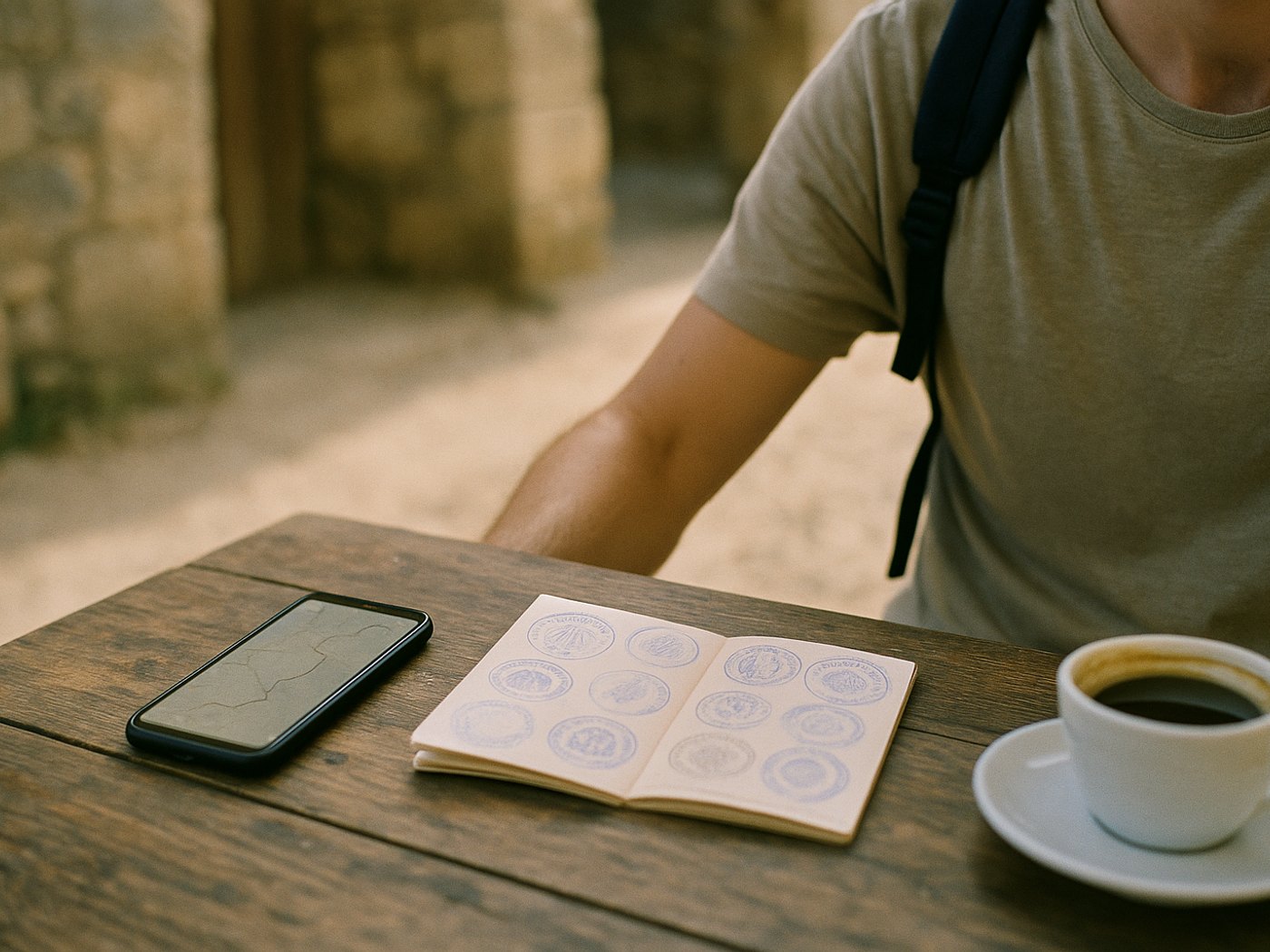
Photo: AI-generated
The phone has become map, guidebook, dictionary, camera and contact with home, all in one pocket. That makes it the most useful thing in the backpack and the most vulnerable.
The short answer to what you need to sort out beforehand: download the maps in advance, check how much EU data your plan includes, and bring a power bank.
EU roaming covers the whole route
If you walk the Camino in France, Spain or Portugal, you are inside the EU, and your Danish plan works as it does at home. Calls, texts and data count against your ordinary usage.
There is one detail that surprises people. Many plans have a lower data allowance abroad than in Denmark, because the rules allow a fair use limit. If you have unlimited data at home, your operator may set a cap on how much you can use in the EU, and the cap is worked out from the price of your plan. The operator has to tell you what the limit is, and it is written in the terms nobody reads.
Check the figure before you travel. If yours is low, or you pay too much for what you use, then compare Danish mobile plans and see what one with more data costs. The overview can be filtered on data and price, so it is easy to see what your own size of plan goes for.
Coverage on the route
On the Camino Francés there is coverage in almost every village. The places where it drops out are predictable: over the Pyrenees between Saint-Jean and Roncesvalles, parts of the Montes de León, and the highest parts of the Camino Primitivo.
Those are also exactly the places where you most want to be able to look at a map. That is why the answer is offline maps, and better coverage would not solve it.
Download it before you travel
Five things that should be on the phone before you leave home:
- Offline maps of the whole route. Organic Maps and Maps.me can download whole regions, and they work without a connection.
- GPX tracks for the route, if you use an app that can read them.
- Google Translate with Spanish downloaded. It works offline and is better than nothing in a pharmacy in a small town.
- Music and podcasts for the long days. A three-hour playlist takes up around 200 MB, once.
- Screenshots of the important things: flight tickets, insurance card, the first night’s accommodation, contact details. They work when nothing else does.
Power is the real bottleneck
In an albergue with forty beds there may be eight sockets, and they are taken from mid-afternoon. It is the most common frustration on the route, and it is easy to solve.
- A 10,000 mAh power bank gives two to three full charges. That is enough for two days without a socket, and the choice between the types is covered in power bank for hiking.
- A short cable instead of a long one. The socket is often right above the bed.
- Flight mode while you walk. The phone uses extra battery searching for a network when coverage is poor. With the map downloaded you can walk all day in flight mode.
- A three-way socket adapter weighs very little and makes you the most popular pilgrim in the room.
The battery on a walk
GPS tracking costs battery all day, and more with the screen on. If you want to track the whole route, use an outdoor watch for it and leave the phone in your pocket.
Cold also takes its toll on the battery. If you walk in the winter half of the year or high up, keep the phone in an inside pocket instead of at the outside of the backpack.
And then the good advice nobody asks for
The phone is useful, and it is also the easiest way to walk the Camino without being there. Put it away during the hours you walk. You only need the map if you are in doubt, and the yellow arrows show the way without help.
The rest of what to bring is in the Camino packing list.
Frequently asked questions
Can I use my Danish mobile plan in Spain?
How much data do I use per day?
Is there enough power in the albergues?
Do I need a Spanish SIM card?
Camino King
The walker who never stopped
Michael walked his first Camino in 2016 and has kept going ever since. He writes about the routes, the gear and everything that makes a long walking day good. If it is here, it has been walked, worn or weighed.
Read next
 Gear Power bank for hiking: 10,000 or 20,000 mAh? How to pick the right power bank for long hikes and the Camino. Capacity, weight, ports and flight rules explained by a hiker who learned the hard way.
 Packing The Camino packing list, tested on several routes A field-tested Camino packing list from a hiker who has walked several routes. What to bring, what to leave at home, and answers to common questions. Gear Outdoor watches: GPS, battery life and what matters Buying an outdoor watch for the Camino or your next hike? My guide to GPS, battery life, altimeter, heart rate and the features that matter on the trail.