No signal on the Camino: what to download and print
There are stretches with no coverage, and days when the phone dies. Here is what to have downloaded and printed before you leave home.
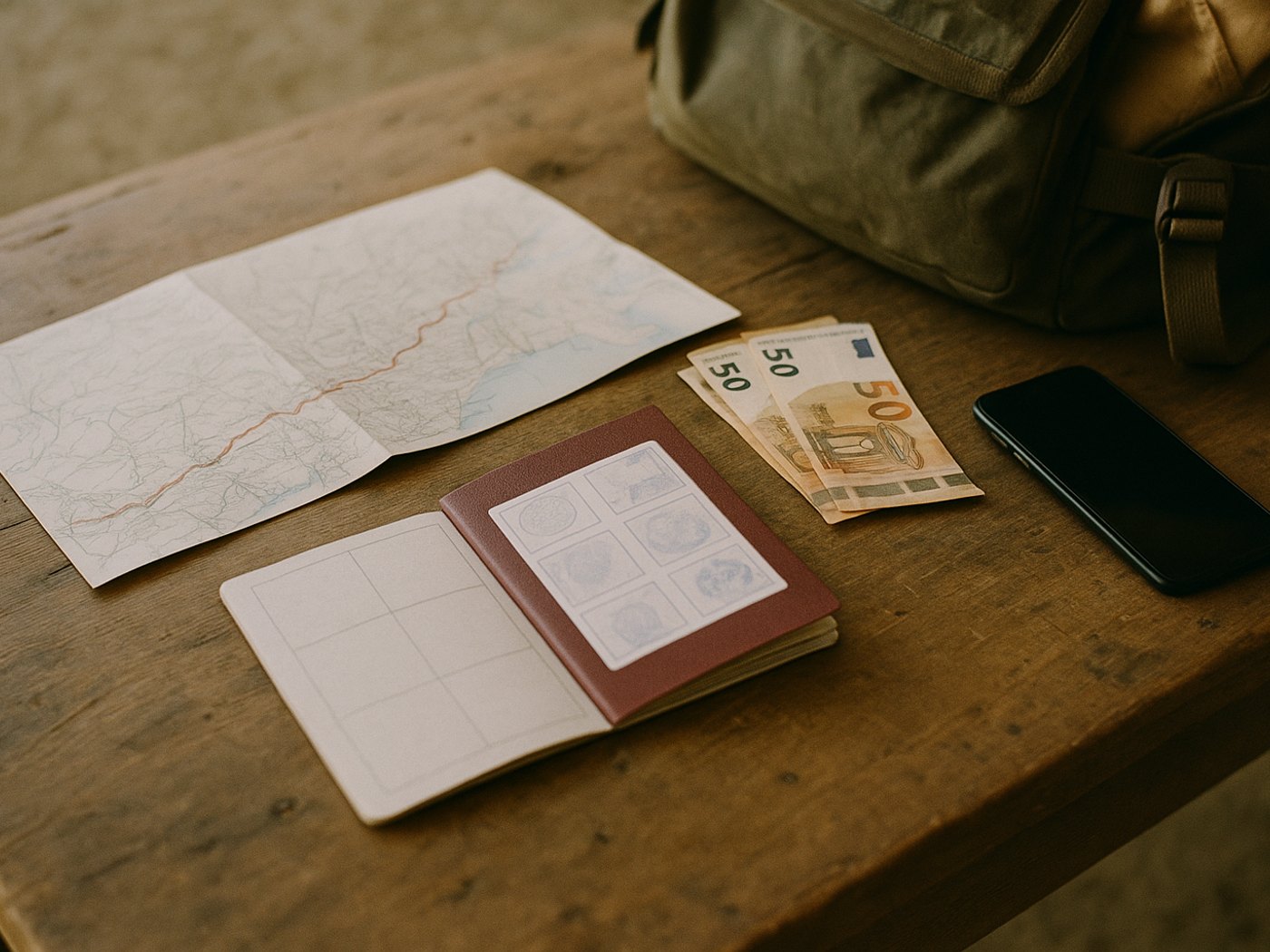
Photo: AI-generated
The Camino is well waymarked, and the yellow arrows showed the way long before anyone had a phone. Even so, there are days when it is good to be able to look at a map, and they tend to be the days when there is no signal.
The short answer to how you prepare: download maps, language and entertainment before you leave, print what has to work no matter what, and carry cash.
Where the signal disappears
Coverage on the Spanish routes is better than its reputation, and the gaps are predictable:
- The climb from Saint-Jean-Pied-de-Port over the Pyrenees to Roncesvalles
- The Montes de León around Cruz de Ferro and Manjarín
- The highest parts of the Camino Primitivo, especially the Hospitales route
- Indoors in thick-walled albergues, where there is otherwise coverage outside
Those are exactly the places where the weather can change, and where it is worth knowing how far it is to the next roof.
What to download
Do it on an evening when you are at home with a good connection. Altogether it comes to two to four gigabytes:
- Offline maps of every region on your route. Organic Maps and Maps.me can download a whole region, and they work without a connection afterwards.
- GPX tracks for the route, if your app can read them. They are most useful on the routes where the waymarking is sparse.
- Google Translate with Spanish downloaded, so it works offline. It is worth having in a pharmacy or at an out-of-hours doctor.
- Music, podcasts and an audiobook. Three hours of music in high quality takes up around 200 MB, an audiobook twice that.
- The weather forecast as a screenshot in the morning, if you are heading into a stretch without coverage.
If it goes slowly, or the connection at home cannot deliver it in one evening, it is worth seeing what can really be delivered at your address. A Danish overview of internet providers with an address check shows which providers cover where you live, and whether it is fibre, coax or 5G. The differences between two streets in the same town are bigger than people expect.
What to print
Paper has the advantage that it works when nothing else does. Five things are worth having in a zip pocket:
- Flight and train tickets, both ways
- Your insurance card and the blue European Health Insurance Card
- The confirmation of your first night’s accommodation
- A list of stages with towns and distances
- Two contact numbers, your own next of kin and your insurer
Put them in a freezer bag. It rains in Galicia.
Cash is not old-fashioned
The smallest albergues, the donativo boxes and the small bars in the villages do not take cards. There are cash machines in the larger towns and none in the smallest, and they can be empty on Sundays.
Always carry enough cash for two nights’ accommodation and two days of food. It is the simplest insurance against a day when the system is down.
The battery is what really fails
A phone without power is offline no matter how many maps are stored on it. That is why a power bank belongs in the same section as the maps, and so does the habit of switching to flight mode.
The details on data, roaming and charging are in your phone on the Camino. And a headlamp belongs in the same category: it has to work when you set off at half past five in the dark, and it should not depend on anything else.
The old system still works
The yellow arrows, the scallop shell and the other pilgrims ahead of you are still the most reliable navigation on the Camino. The map is for the times when you are in doubt, and for the stretches where you walk alone.
The rest of what to bring is in the Camino packing list.
Frequently asked questions
Are there stretches without coverage on the Camino?
Which offline map app should I use?
Should I print anything before I travel?
How much should I download before I leave?
Camino King
The walker who never stopped
Michael walked his first Camino in 2016 and has kept going ever since. He writes about the routes, the gear and everything that makes a long walking day good. If it is here, it has been walked, worn or weighed.
Read next
 Planning Your phone on the Camino: data, roaming and power Your phone is map and guidebook in one, and it soon becomes a bottleneck. Here is what to know about EU data, power in the albergues and apps that work.
 Packing The Camino packing list, tested on several routes A field-tested Camino packing list from a hiker who has walked several routes. What to bring, what to leave at home, and answers to common questions. Gear Headlamps for hiking: how to choose the right one Do you need a headlamp on the Camino or a hike? My guide to lumens, weight, rechargeable or battery power, red light in the albergue and what matters most.