Planning
Bed bugs on the Camino: how to avoid and handle them
Bed bugs do not spread disease, but they itch. See how to check a bed, what a 60 degree wash and a hot dryer do, and how to keep them out of your home.
Bed bugs are unpleasant, but they are not dangerous. The US Centers for Disease Control and Prevention (CDC) states that bed bugs are not known to spread diseases to people, and the bites usually clear up on their own in a week or so.
The best way to avoid them is to check the bed before you unpack and to keep your backpack closed. If you get them anyway, the answer is heat: a wash at 60 degrees Celsius and a hot tumble dryer for at least 30 minutes.
What bed bugs are
Bed bugs are small, flat, reddish-brown insects without wings. According to the CDC they are between 1 and 7 millimetres long, and the UK National Health Service (NHS) gives around 5 millimetres for adults. They bite people at night and hide during the day in mattress seams, bed frames, cracks and crevices. The CDC writes that they tend to live within 8 feet, about 2.5 metres, of where people sleep.
The pest laboratory at Aarhus University in Denmark writes that bed bugs are spread predominantly with clothing, luggage and furniture. That is why they can turn up anywhere many travellers sleep one after another, and the CDC names hotels as one example. This article gives no figures for how common they are on the Camino, because no credible count was found.
How to recognise bites and signs
| Sign | What it looks like |
|---|---|
| Bites | Raised, itchy marks, often in a line or a group, on skin that was uncovered during the night |
| Blood spots | Small rust-coloured spots on the sheet or mattress |
| Droppings | Small brown or black spots on bedding, mattress or furniture |
| Skins | Empty skins shed by bugs that have moulted |
| Bugs | Live bed bugs in the folds and seams of mattress and sheet |
| Smell | A sweet, musty odour |
The bites look similar to mosquito and flea bites. According to the CDC, most people do not notice the marks until one to several days after the bite, and for some it can take up to 14 days. The Aarhus laboratory writes that people differ greatly in how sensitive they are, and that some are not bothered at all. Bites alone are therefore not enough to establish that bed bugs are present. Look for the signs in the bed.
Prevention backed by evidence
The CDC’s advice for travellers is short and can be used directly in a pilgrim hostel:
- Look carefully at the mattress, bedding and furniture before you unpack. Eggs and young bugs are very small and easy to overlook.
- Find somewhere else to sleep if you see bugs or signs such as blood spots on the sheet.
- Keep your luggage off the floor, and closed when you are not using it.
- Take out only what you need, and inspect clothing before it goes back in.
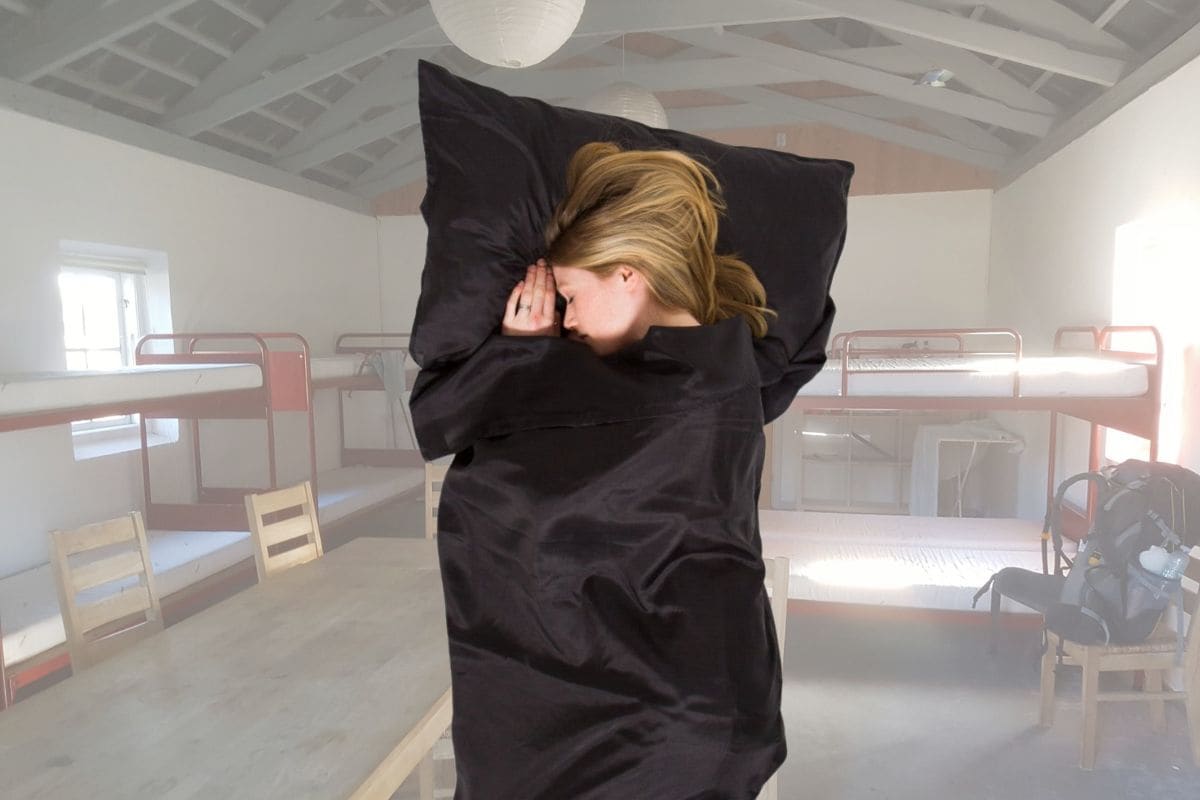
Since the bugs hide in mattress seams and bed frames, it also makes sense to keep the backpack away from the bed itself. A sleeping bag liner or a sleeping bag that can be washed at 60 degrees is easy to treat along the way. Check the care label before you buy.
Permethrin
Permethrin is an insecticide in the pyrethroid group. It is approved in the EU as an active substance in insecticides by Commission Implementing Regulation 1090/2014. Which products may be sold depends on the country, and they must be used according to the label.
No health authority was found that recommends treating a sleeping bag or backpack against bed bugs. The CDC’s travel advice on bed bugs does not mention permethrin, and the US Environmental Protection Agency (EPA) states that some bed bug populations have become resistant to pyrethroids.
If you get bed bugs
- Tell the hospitalero straight away, so the bed can be inspected and treated and the next pilgrims are spared.
- Put clothes and sleeping gear in a sealed plastic bag until they can be washed. The EPA recommends transporting laundry in plastic bags.
- Wash at 60 degrees and tumble dry on a hot setting for at least 30 minutes.
- Empty the backpack and check seams, pockets and straps. Whatever cannot be washed stays in a sealed bag until it can be heated or frozen.
| Method | Temperature and time | Source |
|---|---|---|
| Washing | 60 degrees | NHS, Naylor and Boase 2010 |
| Tumble dryer | Hot setting for at least 30 minutes | NHS, Naylor and Boase 2010 |
| Other heat | 48 degrees for 71.5 minutes, or at least 50 degrees everywhere the bugs can hide | Kells and Goblirsch 2011 |
| Freezing | Minus 18 degrees for three days | EPA |
The eggs are the most tolerant. In the 2011 study, 99 per cent of adults died at 48.3 degrees, while the eggs required 54.8 degrees. The EPA mentions that a black plastic bag in a hot, closed car in the sun can work, but that the result depends on the climate. That method is therefore uncertain for a backpack, and a hot tumble dryer is the safe choice for everything that can take it.
For the itching, the NHS advises something cool, such as a clean, damp cloth. A pharmacist can suggest a mild hydrocortisone cream or antihistamines. See a doctor if the bites are still very painful, swollen or itchy after treatment, or if the swelling spreads. How to see a doctor in Spain is covered in the guide to insurance, health and safety on the Camino.
How not to bring them home
The Aarhus laboratory advises going through your luggage when you get home after a night somewhere bed bugs were present or suspected. Do it outside the bedroom, and go through everything on your packing list.
- Wash everything that can take it at 60 degrees and dry it on a hot setting for at least 30 minutes.
- Freeze what cannot be washed at minus 18 degrees. The Aarhus laboratory gives a couple of days and the EPA three days. The EPA recommends measuring the temperature with a thermometer, because not every freezer is cold enough.
- Check the backpack thoroughly in seams and pockets.
- Items that can be neither washed, heated nor frozen can, according to the EPA, be left in a sealed plastic bag or container for up to a year.
Putting the backpack in a cupboard and waiting is not a solution. According to the Aarhus laboratory, an adult bed bug can manage a couple of months without blood at room temperature.
This article is general information and not medical advice.
Frequently asked questions
Are bed bugs dangerous?
What do bed bug bites look like?
What temperature kills bed bugs?
What do you do if you find bed bugs in a pilgrim hostel?
Does permethrin work against bed bugs?
How do you avoid bringing bed bugs home?
Camino King
The walker who never stopped
Michael walked his first Camino in 2016 and has kept going ever since. He writes about the routes, the gear and everything that makes a long walking day good. If it is here, it has been walked, worn or weighed.
Read next
 Gear Sleeping bag liners: cotton, silk, fleece, or skip the bag A sleeping bag liner can replace or upgrade your sleeping bag on the Camino. Here is how cotton, silk and fleece compare, and when to bring one. Gear Sleeping bags for hiking: comfort temperature explained Buying a sleeping bag for the Camino? Here is my guide to comfort temperature, weight, liners, washing and packing, so you sleep well on the route.
 Packing The Camino packing list, tested on several routes A field-tested Camino packing list from a hiker who has walked several routes. What to bring, what to leave at home, and answers to common questions.